
October 2026
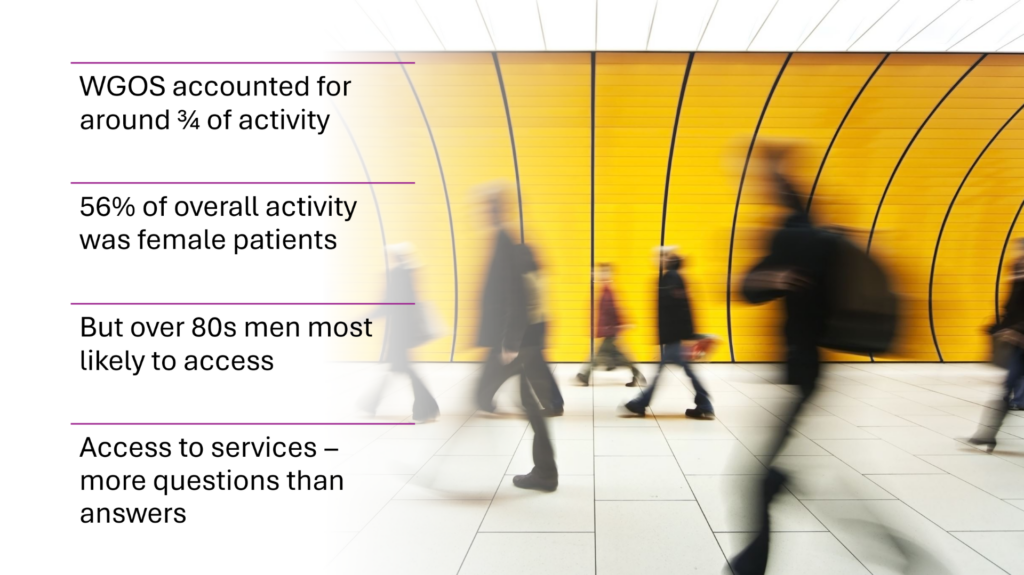
As you know, periodically we ask you to partake in WGOS Service Insights. This is NHS Wales’ opportunity to listen to your views and perspectives. We’re grateful for your engagement.
This communication gives feedback on the particular insight that explored activity and access to WGOS and private services.
The infographic shows significant age‑ and gender‑related disparities in access to eye care. Women were more likely to attend across most age groups, with male predominance only in the oldest cohorts. These disparities cannot be explained solely by disease prevalence, suggesting broader determinants including socioeconomic, geographic, and cultural factors may play a role. Ensuring equitable access requires gender‑sensitive approaches, routine collection of disaggregated data, and regular review of NHS policy frameworks.
Further reading can be found here: Equity in Uptake of NHS and Private Optometry Services in Wales by Age and Gender – PubMed
September 2026

As you know, periodically we ask you to partake in WGOS Service Insights. This is NHS Wales’ opportunity to listen to your views and perspectives. We’re grateful for your engagement.
This communication gives feedback on the insight that explored environmental views in WGOS.
The profession demonstrated strong agreement that anthropogenic climate change is a significant issue and one that health systems have a responsibility to act upon.
The insight also demonstrated that those within the profession who were aware of the Well-being of Future Generations (Wales) Act (WBFG) were overwhelmingly likely to realise that its scope does apply to Optometry.
Interestingly, when it comes to taking action to be sustainable, the profession are twice as likely to report that their employer is taking adequate actions than NHS Wales.
For more information on WBFG, look here: The Well-being of Future Generations | GOV.WALES
For more information on actions you can take, look here: Greener Primary Care Wales – Public Health Wales